Monika Nalepa
  • Home
  • TJ and Democratic Stability
  • Research
  • Teaching and Advising
  • Vita
  • Media Appearances
  • Dogs
  • Contact

Transitional                       Authoritarian            European          
Justice &Backsliding       Legacies                      Politics                                      

​​
  1. "A Wolf in Sheep's Clothing: Citizen uncertainty and Democratic Backsliding'' (with Caterina Chiopris and Georg Vanberg) Journal of Politics 87(4):  1272-87.
  2. "Democratic Backsliding in Poland in Light of Rule of Law Accountability to the European Union" (with Caterina Chiopris) Emory Law Journal 6: 1317-31.
  3. "Democracy's Chance: The Shaping of Public Opinion Through Transitional Justice" (with Egor Bronnikov).
  4. Theories of Democratic Backsliding (with Edoardo Grillo, Zhaotian Luo, and Carlo Prato), Annual Review of Political Science
  5. Mass or Elite Polarization as the Driver of Authoritarian Backsliding? Evidence
    from 14 Polish Surveys (2005–2021)
     Journal of Political Institutions and Political Economy. Forthcoming. (with Ipek Cinar). Appendix
  6. Transitional Justice Options for Post-War Russia (with Thomas F. Remington) Post-Soviet Affairs 39 (6): 406-419.
  7. Mass or Elite Polarization and Demand for Transitional Justice? Evidence from Polish surveys (1992-2007) ​(with Ipek Cinar) Journal of Political Institutions and Political Economy 3(3–4): 433-448 
  8. Can Transitional Justice Improve the Quality of Representation in New Democracies? (with Milena Ang) World Politics 71 (4): 631-666.  Replication  Online Appendix 
  9. “Accountability by Numbers: A New Global Transitional Justice Dataset ” (with Genevieve Bates and Ipek Cinar) Perspectives on ​Politics (FirstView, June 26, 2019)
  10. "The Role of Domestic Opposition and International Justice Regimes in Peaceful Transitions of Power." Journal of Conflict Resolution 60(7): 1191-1218
  11.  "A Model of Strategic Preemption: Why Do Post Communists Hurts Themselves?" Decyzje 21(2): 31-65, with Marek M. Kaminski).
  12. "Tolerating Mistakes: How do popular perceptions of procedural fairness affect demand for transitional justice?" Journal of Conflict Resolution 56 (3): 490–515.
  13. "Reconciliation, Refugee Returns, and the Impact of International Criminal Justice: The Case of Bosnia and Herzegovina." NOMOS,  v.51
  14. "Captured Commitments: An Analytic Narrative Approach to Transitions with Transitional Justice." World Politics 62(2): 341–80.
  15. "Lustration and Survival of Parliamentary Parties." Taiwan Journal of Democracy 5(2): 45–68.
  16. "Punish All Perpetrators or Protect the Innocent? Comparing Systems of Transitional Justice." Journal of Theoretical Politics 20(2): 221–45. Appendix.
  17. "Judging Transitional Justice: A New Criterion for Evaluating Truth Revelation Procedures." Journal of Conflict Resolution 50(3): 283–408.
  18. "Strategic and Normative Aspects of Transitional Justice." Journal of Conflict Resolution 50(3): 295–303.
  19. "What Can Quantitative and Formal Models Teach us About Transitional Justice?" (with Milena Ang) in Oxford Handbook of Transitional Justice
  20. "The Institutional Context of Transitional Justice." In Handbook of Comparative Political Institutions, eds. Jennifer Gandhi and Ruben Ruiz-Rufino, London: Routledge. 
  21. “What is the effect of Personnel Transitional Justice on Crime?” (with Genevieve Bates, Ipek Cinar, and Evgenia Olimpieva)
  22. "Critical Dialog [between authors of Skeletons in the Closet: Transitional Justice in Post-Communist Europe and James L. Gibson  Overcoming Historical Injustices: Land Reconciliation in South Africa In Perspectives on Politics 10(2).
  23.  "Lustration", "Institute for National Remembrance", and "Poland."In Cambridge Encyclopedia of Transitional Justice, eds. Lavinia Stan and Nadia Nedelsky. New York: Cambridge University Press,
  24. "The Origins of Competing Claims to Land in East Central Europe: In-kind Restitution as a Problem of Fair Division." In Distributive Justice in Transitions, eds. Morten Bergsmo, César Rodriguez-Garavito, Pablo Kalmanovitz and Maria Paula Saffon. Oslo, Norway: PRIO Forum for International Criminal and Humanitarian Law Publication, Series 6.
  25.  "Infiltration as Insurance: Committing to Democratization and Committing Peace." In Law in Peace Negotiations, ed. Morten Bergsmo Torkel Opsahl. Norway: Academic EPublisher).

  1. "From Anti-Authoritarian Resistance to Democratic Resilience: Legacies of Solidarity in Poland's backsliding era." (with Hanna Folsz)
  2. "Purging the Police in Nascent Democracies" (with Barbara Piotrowska)
  3. Authoritarian Infiltration of Organizations: Causes and Consequences." Journal of Politics 84 (2) (with Grigore Pop-Eleches). Appendix​
  4. "Transitional Justice and Authoritarian Backsliding"  Constitutional Political Economy ​(OnlineFirst)
  5. "Fragile democracies and constitutional crises: a laboratory for studying the role of constitutional constraints" (with Emilia Justyna Powell)​ Constitutional Political Economy: ​​​

Books

Picture

Skeletons in the Closet: Transitional Justice in PostCommunist Europe
Cambridge University Press, 2010.

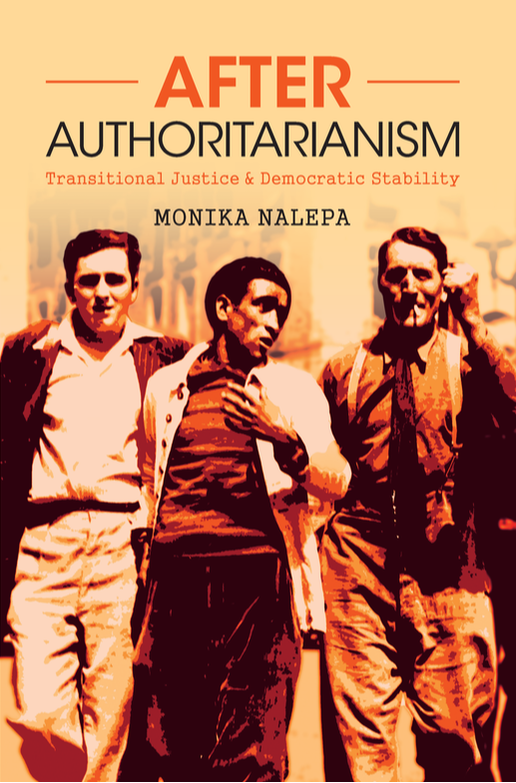
After Authoritarianism: Transitional Justice and Democratic Stability
Cambridge University Press, 2022. 

Picture

Game Theory and Social Choice:​

"A Classroom Experiment on Threshold Public Good" in eds. Derek Glasgow, Mark Harvey, Ryan Gibb, James Fielder. Short Games and active learning in Political Science: Beating the Clock Routledge.

"Modeling self-selection into vetting institutions: An application to purges in nascent democracies" (with Barbara Piotrowska) in eds. Olga Shvetsova  The Handbook of Strategic Analysis of Politics, Elgar


  1. "Transitional Justice and Tax Capacity." (with Simone Paci)  WIDER Working Paper Series WP-2025-92, World Institute for Development Economic Research (UNU-WIDER).​
  2.  "Does Voters’ Preference for Transitional Justice Precede Elite Polarization: Evidence from Polish surveys (1992-2005)'' In Oxford Handbook of Polish Politics, eds. Katarzyna Grzybowska-Walecka, Simona Guerra, and Fernando Casal Bartoa.
  3. Revisiting Electoral Personalism (with Jose Cheibub) Journal of Theoretical Politics 32 (1):1-10
  4. "Gradual Erosion of the Individual Mandate and the Shift to Majoritarianism in Poland" PS: Political Science & Politics, 52(2): 271-2.​
  5. "Party Institutionalization and Legislative Organization: The Evolution of Agenda Power in the Polish Parliament." The Journal of Comparative Politics 48(3): 353-372. Appendix
  6. "Agenda Setting: the Third Pathway to Voting Unity. Evidence from the Polish Parliament" Studies in Logic, Grammar and Rhetoric 50(63): 181-213.
  7. When Does the Personal Vote Matter for Party Loyalty? The Conditional Effects of Candidate-Centered Electoral Systems (with Royce Carroll), Parliamentary Affairs, Parliamentary Affairs 74(1): 102–120. 
  8. The Personal Vote and Party Cohesion: Modeling the Effects of Electoral Rules on Intra-party Politics (with Royce Carroll) Journal of Theoretical Politics 32 (1): 36-69.​​
  9. Poland: the Road to Authoritarianism in Paved by Gradual Majoritarian Shifts" in "Legislative Decline in the 21st Century a Comparative Perspective." Taylor and Francis 2020, eds. Irina Khmelko, Michael Mezey, and Frederick Stapenhurst.  
  10.  "Learning to Manipulate Electoral Rules," In Handbook of Electoral System Choice, ed. Josep Colomer. London: Palgrave-Macmillan (with Marek Kaminski)
IN POLISH: 
  1. Nalepa, Monika. "Sprawiedliwość jako pojęcie transcendentalne: Immanuela Kanta i Simone Weil wyobrażenie o warunkach umożliwiających życie polityczne." ”(“Justice as a Transcendental Concept - Immanuel Kant and Simone Weil” Przegląd Humanistyczny 42, no. 4 (349) (1998).
  2. Nalepa, Monika. 1997. “Johna Rawlsa liberalizm bez ideologii” (“John Rawls’ Liberalism Without     Ideology”) Przeglad Filozoficzny. Nowa Seria 4(24): 99–121.
Proudly powered by Weebly
  • Home
  • TJ and Democratic Stability
  • Research
  • Teaching and Advising
  • Vita
  • Media Appearances
  • Dogs
  • Contact